
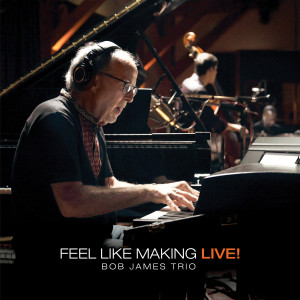
Bob James made his name in fusion and smooth jazz, but some of us believe the pianist’s acoustic trio records represent his highest art. His 1996 album Straight Up, with bassist Christian McBride and drummer Brian Blade, and 2004’s Take It from the Top, with bassist James Genus and drummer Billy Kilson, are career highlights and gems of their genre. Those records will never escape the shadow of 1978’s Touchdown or 1975’s One, but now James gives us the best of both worlds, revisiting his biggest hits in a trio format and tossing in other tunes.
Despite its title, Feel Like Making LIVE! isn’t a concert recording. It was recorded “live in the studio” with old pal Kilson and young bassist Michael Palazzolo, who’s been in James’ bands for several years now. Rather than swing like a bop trio, they play classy, R&B- and pop-tinged jazz that’s both accessible and adventurous.
Continue Reading the Full Review at Jazz Times…
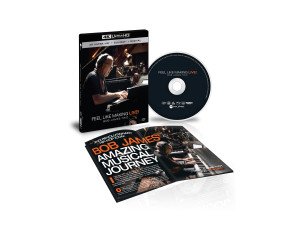 For Jazz enthusiasts and those in the music industry, the name Bob James rings true with that of an accomplished musician and composer. For the unfamiliar, it likely sounds as the most common of names. Rest assured that his accomplishments and skill are not of the common variety though. The 4k Blu-ray release, Feel Like Making LIVE! Bob James Trio, both recaps his background and highlights his band’s talent, with a certain emphasis on the latter. Let’s delve into the DNA of this ultra high definition disc and breakdown the anatomy of its delivery.
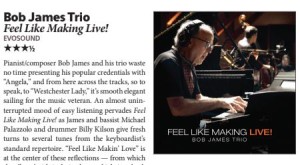 Pianist/composer Bob James and his trio waste no time presenting his popular credentials with “Angela,” and from here across the tracks, so to speak, to “Westchester Lady,” it’s smooth elegant
 Last night, the Bob James Trio played the Dakota Jazz Club in Minneapolis, almost a half century after the ensemble won the Notre Dame Collegiate Jazz Festival. The ensemble leader, jazz keyboardist Bob James, proved more than a one-hit wonder. Having attracted the attention of one of the judges, the great jazz arranger Quincy Jones, James was soon introduced to jazz singer Sarah Vaughan, and
 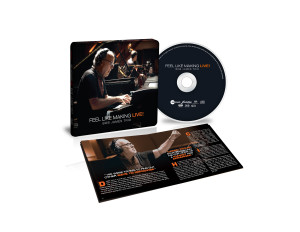 Multi-Grammy Winning Pianist Bob James releases “Feel Like Making LIVE!” as a celebration of his unique artistry, reflecting on a storied career stretching back nearly six decades. On this album he Steps back to his piano trio roots, which is how the Missouri-born musician started his music career back in 1963. The lineup on this release includes bassist Michael Palazzolo along with drummer Billy Kilson and the album was recorded live in the studio as a unique audio-visual spectacular, utilizing the best available filming and recording standards, including Dolby Atmos sound and 4K ultra high definition video.
 Across his almost six-decade career, Bob James’ music has meant many things to different people. To those who have an interest in Creed Taylor’s iconic CTI Records, the memorable label that incentivized artists to merge jazz with ideas from other genres, James is a familiar name. Between his own significant releases and his contributions to albums by artists including Grover Washington Jr., Stanley Turrentine, and Hubert Laws, he was core member of what James refers to as the CTI repertory. To those who love “smooth jazz”, James is one of the founders.
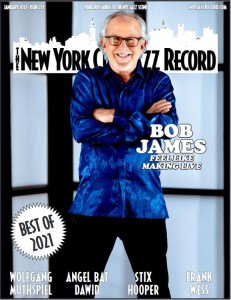 The new year is off and running with FEEL LIKE MAKING LIVE! creating quite the buzz as the cover story of “The New York City Jazz Record”.